

Michael Mann's Heat

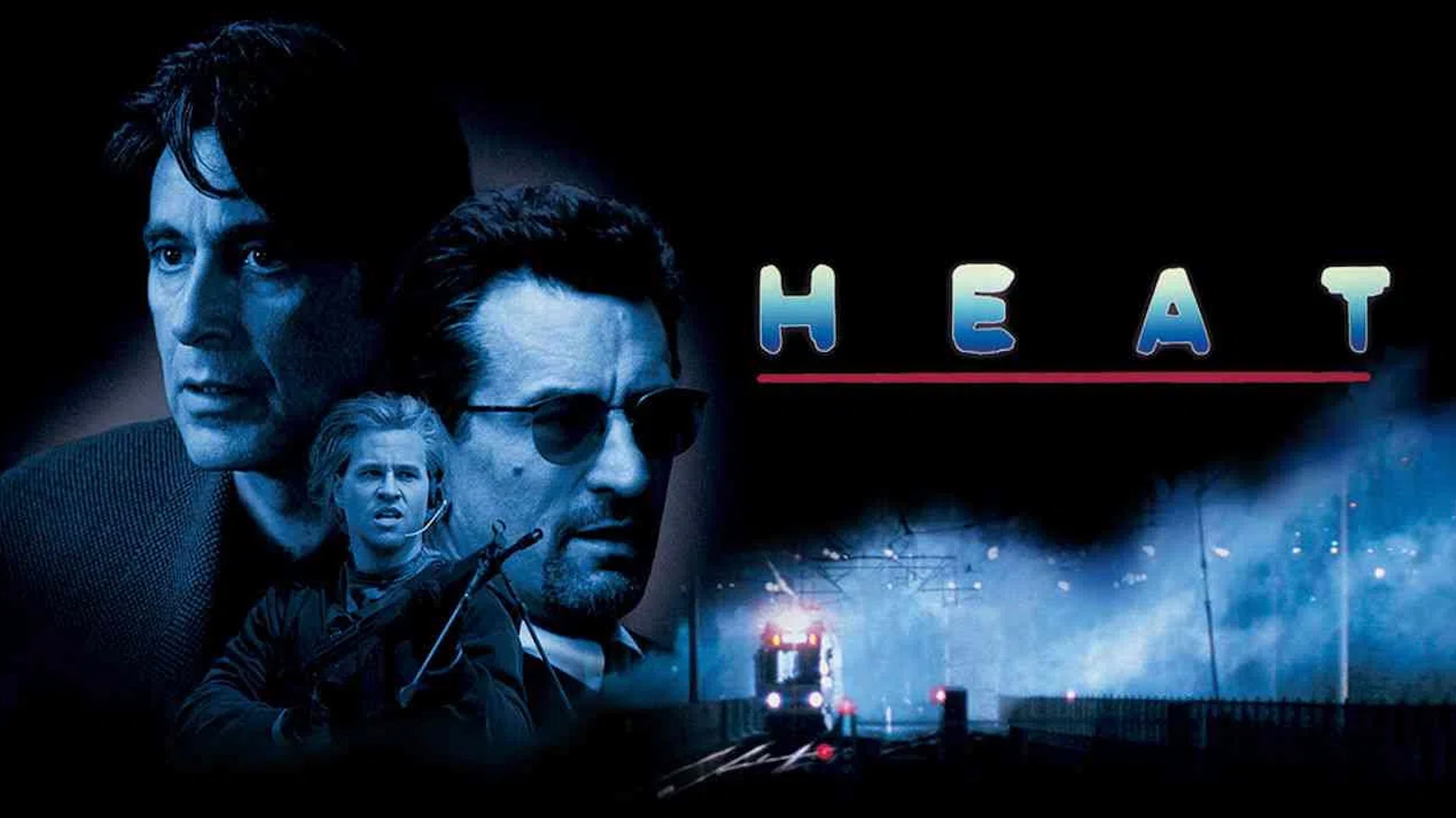
A small note: This was written for a film series based on Mark Fisher’s Capitalist Realism—in case you are wondering why I wrote about a movie from 1995.
Neil McCauley arrives at night, by train, at a station lit up like a spaceship in the dark. His face is Robert De Niro’s face—a pregnant pause made flesh—which is why we watch it so closely. McCauley scans the train platform—carefully, but never conspicuously, and never for too long. He is practiced, observant. He rides the escalator down to street level, and we see, for the first time, that he’s dressed in a paramedic’s uniform. The music, an ambient hum, starts to lower in tone. McCauley approaches a building—a hospital, it turns out—and enters with authority. He breezes through and makes off with an ambulance before the credits have finished rolling.
Cut to Val Kilmer’s Chris Shiherlis (and his misguided ponytail) buying explosives with cash and what we assume—from the look on Kilmer’s face—is a fake i.d. Shiherlis is handsome, charming, but shifty. Perhaps a little too keen, a little too on edge. In fairness, he is buying a bomb.
Finally, we meet Lieutenant Vincent Hanna (Al Pacino), draped in sunlight, making love with a woman who we later learn is his wife, Justine (Diane Venora). When they’re finished, Hanna showers. Justine, satisfied, lights a cigarette and asks about breakfast (women are not Michael Mann’s strong suit). But Hanna can’t stay, not even for coffee. He has to go to work.
It’s clear, from the opening scenes, who these men are: McCauley, the professional, is good at what he does but bad at living by society’s rules. (In one of the more literal shots from the opening sequence, we see him walking overtop of a traffic arrow, painted on the road, pointing in the opposite direction.) Shiherlis, with long hair and a box full of explosives, is the hot head—charming, capable, but rash, prone to acting without thinking. Hanna, the cop in a story about cops and robbers, is well-intentioned, but he works too hard. He’s trying to satisfy everyone; he is bound to fail. These three are our protagonists. None, we learn, is a good guy. But they aren’t bad guys either. Each of them is just a man who can’t—or won’t—connect.
But connection—or perhaps interconnectedness—spreads like a virus in Heat. And when a heist goes sideways, thanks to a loose cannon named Waingro, we watch circumstance stitch our protagonists—along with a slew of supporting characters—together. The plot, then, is about whether they will be able to cut themselves free, and what relationships will be sacrificed in the process.
But the film yearns to be more than just a heist movie, more than just a thriller—which is too bad because as a thriller, it’s great. Mann, I think, wants to tell a story about men, about their inner turmoil, their demons—which, apparently, are best exercised with money, guns, and very little chit-chat (“Yeah. Stop talking, okay Slick?“). The film, through this lens, is uninteresting, hinting at depths the characters often lack (a fact well concealed by an incredible cast). But there is another version of Heat that is interesting—at least to me—about our relationship to work.
When it was first released in 1995, Heat was marketed as a meeting—a collision!—of icons: De Niro and Pacino, on screen together for the first time. In truth, the actors share only two scenes. The more memorable, and arguably more important, happens almost exactly halfway through he film. Hanna is tailing McCauley on a busy Los Angeles freeway. It’s night, it’s dark. The two men have been playing cat and mouse, but to this point, they’ve never met face to face. Hanna flashes his sirens, pulls McCauley over, and approaches his car. Each has their gun ready. Watching, we anticipate…what—a shootout? A car chase? Then, unexpectedly, Hanna says to McCauley, “What do you say I buy you a cup of coffee?”
The six minutes that follow are flawless. The two men sit across from one another in a diner. A conversation that begins tersely becomes the most revealing in the film. It, alone, could be a movie.
During their conversation, McCauley, for the second time, drops the name of the film into casual conversation. “A guy told me one time: Don’t let yourself get attached to anything you are not willing to walk out on in thirty seconds flat if you feel the heat around the corner.” This is foreshadowing, of course. But in a film about running jobs, and about connection and disconnection, it is also a statement of priority.
In Capitalist Realism, Mark Fisher argues that Heat, when contrasted with the gangster movies of Coppola and Scorcese, perfectly epitomizes post-Fordist economics. McCauley’s crew are not part of a legacy, not a family. “[They] are held together by the prospect of future revenue…Their arrangement is temporary, pragmatic and lateral—they know that they are interchangeable machine parts, that there are no guarantees, that nothing lasts.” The connection that each character in Heat craves is seen as a liability. To succeed, they must steel themselves to such cravings. McCauley—we can see from his solitary life, his near-empty house—is the steeliest of the bunch.
Back in the diner, McCauley asks Hanna: “Now if you’re on me, and you gotta move when I move, how do you expect to keep…a marriage?” The answer, of course, is that he doesn’t. Hanna’s relationship is as tenuous as McCauley’s. He is, as he says, on the downslope of a marriage. Both will go where the work takes them, and are willing to walk out on relationships, on family, if they need to.
Fisher writes: “The values that family life depends upon—obligation, trustworthiness, commitment—are precisely those which are held to be obsolete in the new capitalism. Yet…the family becomes an increasingly important place of respite from the pressures of a world in which instability is a constant.” When McCauley, at the end of the film, goes to his girlfriend, Eady (Amy Brenneman), it’s clear that he’s seeking that place of respite. Everyone else around him is gone. He asks Eady to come with him, to flee. And when McCauley finds out where Waingro, the loose end that set everything in motion, is hiding out, it seems for a moment like he might actually walk—or in this case, fly—away. The couple drive through a tunnel, headed for the airport, and everything goes bright. Eady, seemingly calm, looks out the passenger window. But McCauley is starting to churn. He’s imagining a world where Waingro goes free. By the time the couple has driven out of the tunnel, back into the night, it’s clear that this unfinished job is the attachment McCauley can’t walk away from.
Near the end of their coffee break, after McCauley and Hanna have accepted their intertwined fates, Hanna opens up about his recurring dream: He’s sitting at a banquet table with all of the victims of the murder cases he’s worked. They don’t say anything, they just stare at him. As dreams go, it’s fairly literal. McCauley, in turn, says he has a dream where he’s drowning, and he has to wake himself up or he’ll die in his sleep. “You know what that’s about?” Hanna asks. “Yeah,” McCauley replies. “Having enough time.”
I think it's one of the very great crime films, perfectly in keeping with it's time. The soundtrack to the shootout scene is mind-blowing in a cinema. A symphony of gunfire. Mind you, Michael Mann has completely ruined it for the 4k release - he's re color-timed it into a drab steel and blue color palette. Directors shouldn't be allowed to screw around with their films post-hoc in my view, unless they also make the original releases available.